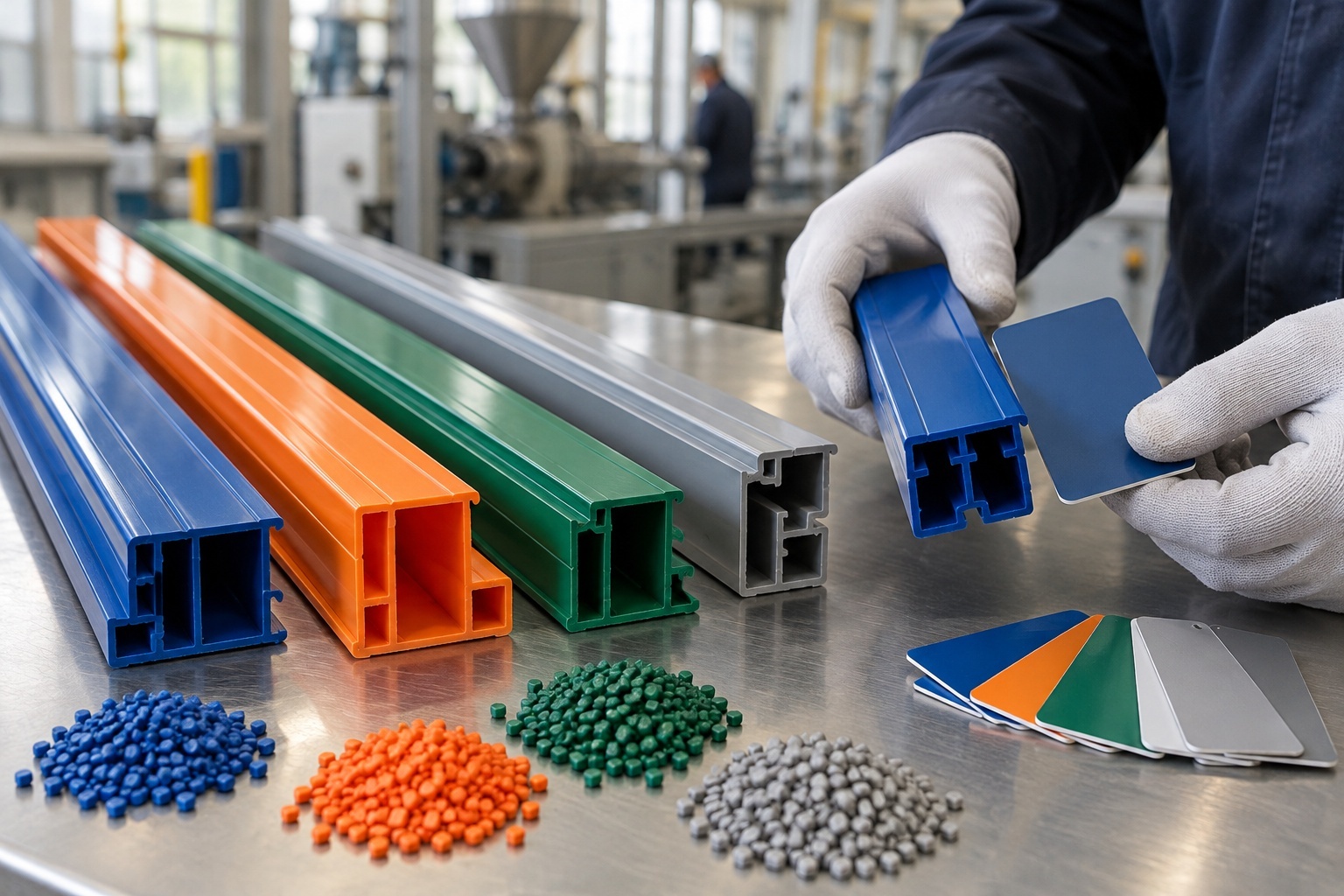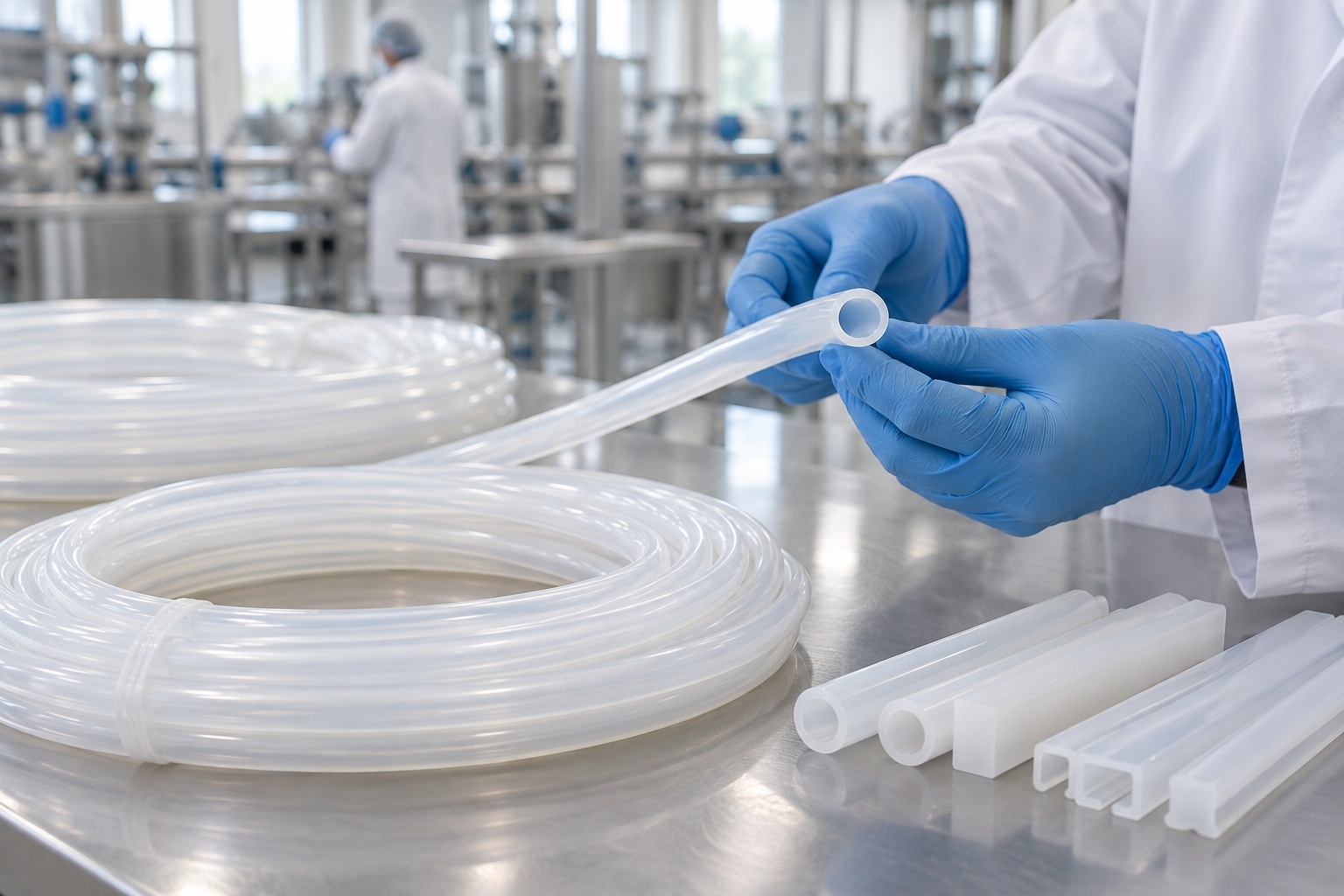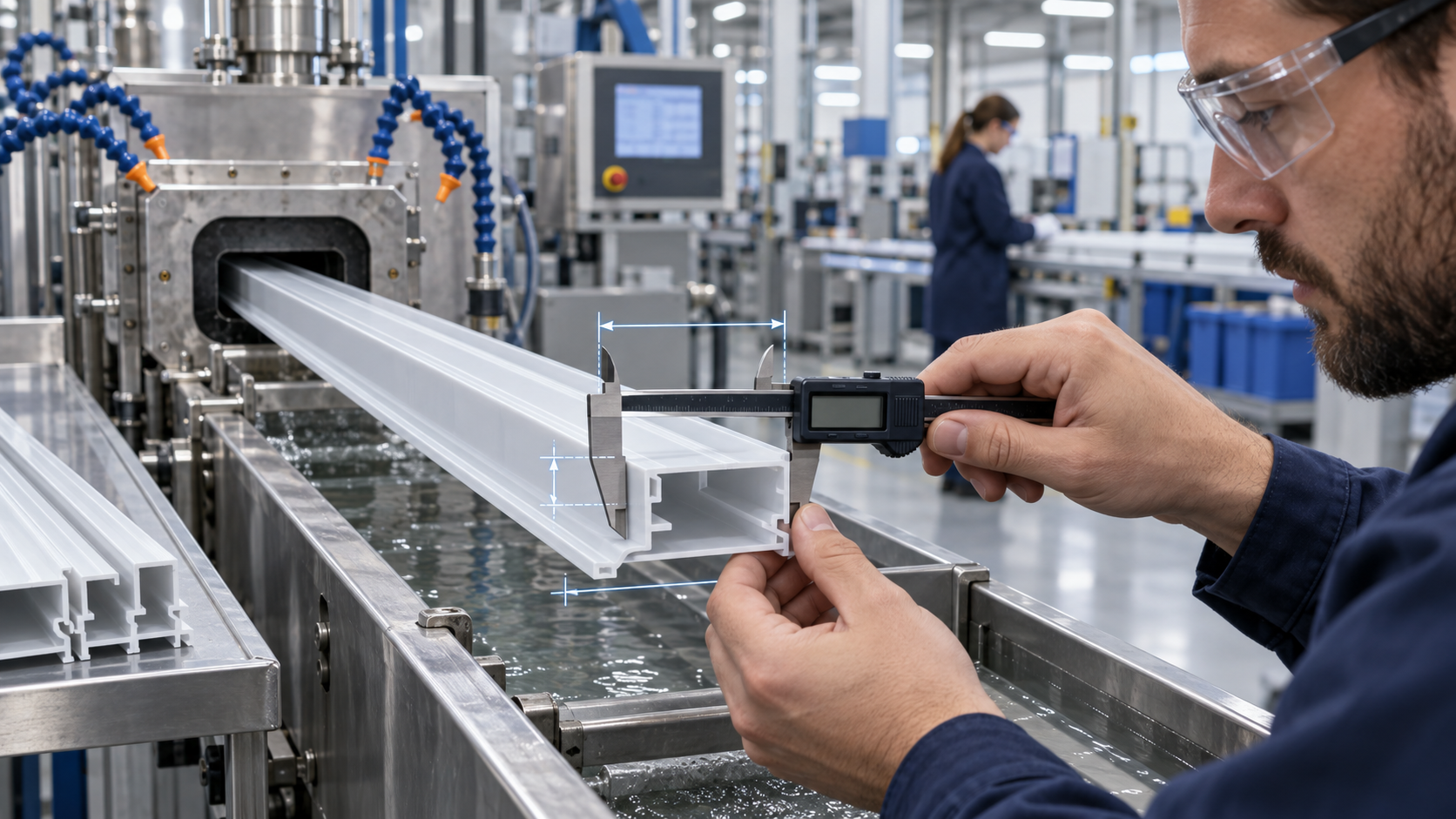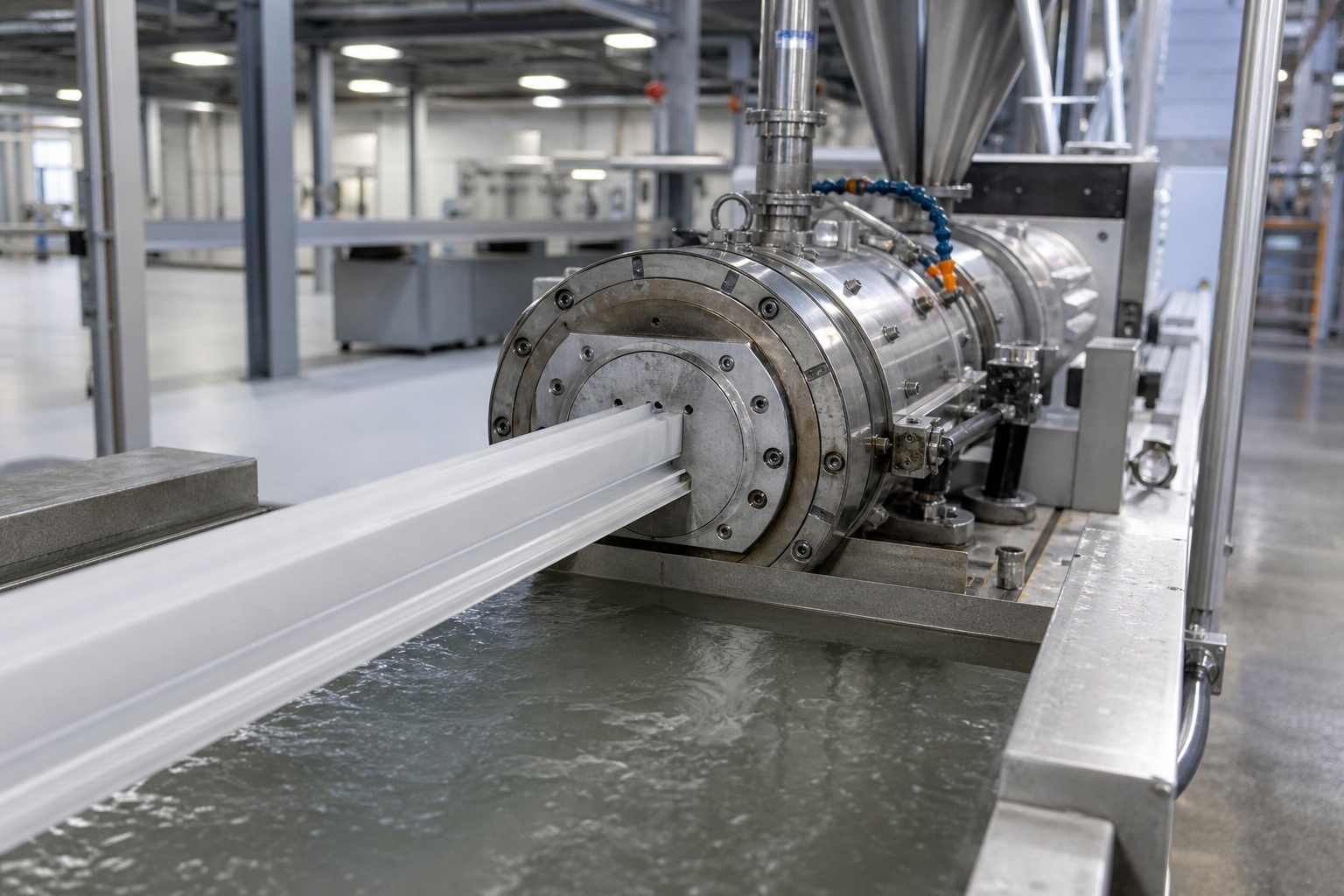
When a single material cannot satisfy every requirement in a part, the usual answers are to compromise on performance, to assemble two components, or to run co-extrusion plastic profiles — bonding two or more materials into one continuous profile in a single pass. Done for the right reasons, co-extrusion removes an assembly operation, improves durability and can cost less per finished part than the single-material alternative it replaces.
Done for the wrong reasons, it adds tooling cost and process complexity for a benefit you could have had from a simple profile in a better-chosen resin. This guide sets out what co-extrusion actually is, where it pays off, what it costs, which material pairings work, and a checklist to decide which route your part should take.
What co-extrusion is
In conventional single-screw extrusion, one resin is melted and pushed through a die to form a continuous profile. In co-extrusion, two or more extruders feed different melt streams into a common die assembly, where the streams meet and bond while still molten. The result is one profile with distinct material zones — a rigid body with a flexible sealing lip, a base resin with a UV-stable cap layer, or a structural core with a decorative skin.
The bond is formed in the melt, not by adhesive or mechanical fastening. Where the materials are chemically compatible, that interface can be as strong as the surrounding material. Where they are not, a tie layer — a third material chosen to bond to both — is introduced between them.
Co-extrusion versus tri-extrusion versus dual durometer
Two materials is the common case. Three or more streams (tri-extrusion) are used where you need, for example, a rigid substrate, a tie layer and a weatherable cap. “Dual durometer” generally describes a specific type of co-extrusion where the same base chemistry appears in both a rigid and a flexible grade — rigid PVC with flexible PVC is the classic example. Our co-extrusion capability page covers the equipment side in more detail.
Common use cases
Rigid body with an integrated flexible seal
The most common reason to co-extrude. A window or door glazing bead with a soft bulb seal, a refrigeration gasket carrier, an equipment enclosure trim with a compliant lip. The alternative is a rigid profile plus a separate gasket that has to be inserted, glued or slid on — an extra part number, an extra operation, and a joint that can fail in service. Integrating the seal typically removes an assembly step and improves sealing consistency.
UV and weatherable cap layers
Outdoor profiles degrade from the surface inward. Rather than loading the whole profile with UV stabilizers and expensive weatherable resin, a thin cap of acrylic, ASA or weatherable PVC over a lower-cost core delivers the surface performance where it matters at a fraction of the material cost. This is the standard approach in windows and doors and exterior trim.
Colour caps and decorative surfaces
Pigment and specialty finishes are expensive. Capping a natural or regrind-containing core with a thin coloured skin gives a premium appearance without colouring the whole cross-section. It also allows two-tone profiles — one colour inside, another outside — that would otherwise require painting or a secondary applied film.
Regrind and recycled cores
A co-extruded profile can carry recycled or regrind material in the core, where appearance and weatherability do not matter, while a virgin cap handles the visible, exposed surface. This is one of the more effective ways to reduce both cost and material footprint without compromising the finished part.
Functional surfaces
Low-friction slip layers on sliding profiles, conductive or anti-static surfaces, barrier layers, and grip surfaces on handles and edges are all co-extrusion applications where the required property only exists at the surface.
Cost and tooling considerations
Co-extrusion is more expensive to set up and can be cheaper to run. Whether it pays off depends on volume and on what it replaces.
Where the extra cost sits
- Tooling. A co-extrusion die is more complex than a single-material die — the streams must meet at the right point, at balanced pressures and compatible melt temperatures. Expect a higher die cost and typically more development iterations.
- Equipment. A second (or third) extruder and feed system must be available and dedicated for the run.
- Setup and scrap. Startup takes longer and generates more scrap than a single-material run, because two flows must be stabilized and balanced simultaneously. This penalty is fixed per run, so short runs feel it most.
- Process control. Layer thickness and interface position are controlled by relative throughput; tighter tolerances on layer thickness mean tighter process control.
Where the savings come from
- Eliminated assembly. Removing a secondary gasket-insertion or bonding operation often outweighs everything above. Count the labour, the fixture, the second part number, the inventory and the scrap from misassembly.
- Material substitution. Using expensive resin only where it is needed can cut material cost significantly on a thick profile.
- Fewer field failures. An integrally bonded seal does not fall out, shift or debond in service the way a mechanically inserted one can.
- Supply chain simplification. One part to buy, stock, inspect and ship instead of two or three.
The volume question
There is no universal breakeven, but the shape of the answer is consistent: the higher the annual volume and the more assembly labour you remove, the faster co-extrusion pays back its tooling premium. Low-volume parts with no assembly step to eliminate are usually better served by a single-material profile — possibly in a different resin. If cost is the main driver, it is worth reading our notes on extrusion versus injection molding first, because the process choice often matters more than the layer strategy.
Material pairing and compatibility
The single most important technical question in a co-extruded design is whether the two materials will bond and stay bonded through the product’s service life.
What governs the bond
- Chemical compatibility. Similar polarity and chemistry bond readily. Rigid PVC with flexible PVC is the most forgiving pairing in the industry. TPE and TPV grades are specifically formulated to bond to given substrates — always specify the grade by intended substrate, not just by durometer.
- Melt temperature overlap. The two materials must have processing windows that overlap. A pairing that requires one resin to run 60°C above its degradation point is not viable regardless of chemistry.
- Viscosity match. Large viscosity differences cause the lower-viscosity material to encapsulate or distort the other at the interface. Melt flow indices should be reasonably close, or the die geometry must compensate.
- Thermal expansion. Dissimilar expansion coefficients create interface stress across the temperature range the part will see. This shows up as curl, warpage or delamination after thermal cycling — not on day one.
- Shrinkage. Differential shrinkage on cooling bows the profile. It is managed with cooling design and layer proportioning, but it has to be anticipated.
Pairings that generally work
Rigid PVC with flexible PVC; PVC with a suitably formulated TPE; ABS or PVC with an acrylic or ASA cap for weatherability; polyolefins with polyolefin-based TPEs; and any pairing where a proven tie layer is specified. Polyolefins bonded directly to polar resins such as PVC, ABS or nylon generally require a tie layer or a mechanical interlock designed into the cross-section.
When the answer is a mechanical interlock
If chemical bonding is marginal, the profile can be designed so that one material physically captures the other — a dovetail or hooked cross-section formed in the die. This is a legitimate and durable approach, particularly for seals that see peel loads. It does constrain the geometry, so raise it early in design.
Decision checklist
Work through these before committing to a co-extruded design:
- Is there a genuine property conflict? Does the part truly need two different hardnesses, surfaces or performance characteristics — or would one well-chosen resin do?
- What assembly does it eliminate? Quantify the labour, fixtures, part numbers and scrap you remove. This is usually where the business case lives.
- What is the annual volume? High and steady volumes amortize tooling quickly; sporadic short runs pay the setup penalty repeatedly.
- Are the materials compatible? Chemistry, melt temperature, viscosity, thermal expansion. Get this confirmed before tooling is cut, not after.
- Which dimensions are critical? Layer thickness tolerances are looser than overall profile tolerances. Do not put a critical dimension on a layer boundary if you can avoid it.
- What is the service environment? UV exposure, temperature range, chemical contact and thermal cycling all bear on the interface, not just on the individual materials.
- Is the cross-section manufacturable? Very thin caps, sharp transitions between hard and soft zones, and large wall-thickness variations are all harder to run consistently.
- Does it need to be recyclable as a single stream? Mixed-chemistry profiles complicate end-of-life recycling; same-family pairings do not.
- How will you inspect the bond? Agree an acceptance test — peel, adhesion or cross-section — at the quoting stage.
The honest summary: co-extrude when the part has a real, irreconcilable conflict between two required properties, or when it eliminates an assembly operation at volume. Otherwise, a single-material profile in the right resin is faster to tool, cheaper to run and easier to change. Our guide to custom extrusion for the construction industry shows how both routes are used in practice.
Frequently asked questions
How many materials can be co-extruded in one profile?
Two and three are routine. More is technically possible but each additional stream adds a die channel, an extruder and another balancing variable, so it is reserved for applications that genuinely require it.
Can co-extruded materials be separated for recycling?
Not easily when the bond is good — which is the point. If single-stream recyclability is a requirement, specify materials from the same polymer family so the whole profile can be reprocessed together.
How thin can a cap layer be?
Practical cap layers are typically a few thousandths of an inch upward. The floor is set by how consistently the thin stream can be held across the full profile width; very thin caps demand tighter process control and better die design.
Does co-extrusion affect dimensional tolerances?
Overall profile tolerances are broadly comparable to single-material extrusion. Layer thickness carries a wider tolerance, so design so that critical fits do not depend on a layer boundary.
Can you co-extrude with recycled material?
Yes — placing regrind or recycled content in the core with a virgin cap is one of the most common and cost-effective uses of the process.
What information do you need to quote a co-extruded profile?
A dimensioned drawing with tolerances, the intended service environment, both material specifications or the performance requirements behind them, annual volume, and any colour or finish requirement.
Talk it through before you tool it
Most of the cost in a co-extruded profile is committed on the day the die is designed. An early conversation about material pairing, wall thicknesses and which dimensions are truly critical is the cheapest engineering you will ever buy.
Contact Accord Plastics with your drawing or your requirements and we will tell you honestly whether co-extrusion is the right call for your part.