If you are sourcing a new plastic component, one of the first decisions on the table is plastic extrusion vs injection molding. Both processes melt thermoplastic resin and force it into a shape, both scale to millions of parts, and both can hit tight tolerances in the right hands. But they solve fundamentally different problems, and choosing the wrong one early can lock you into tooling that costs five to ten times more than it needed to.
This guide breaks down how each process works, what drives cost, and a simple decision framework engineers and procurement managers can use before requesting a quote.
How Plastic Extrusion Works
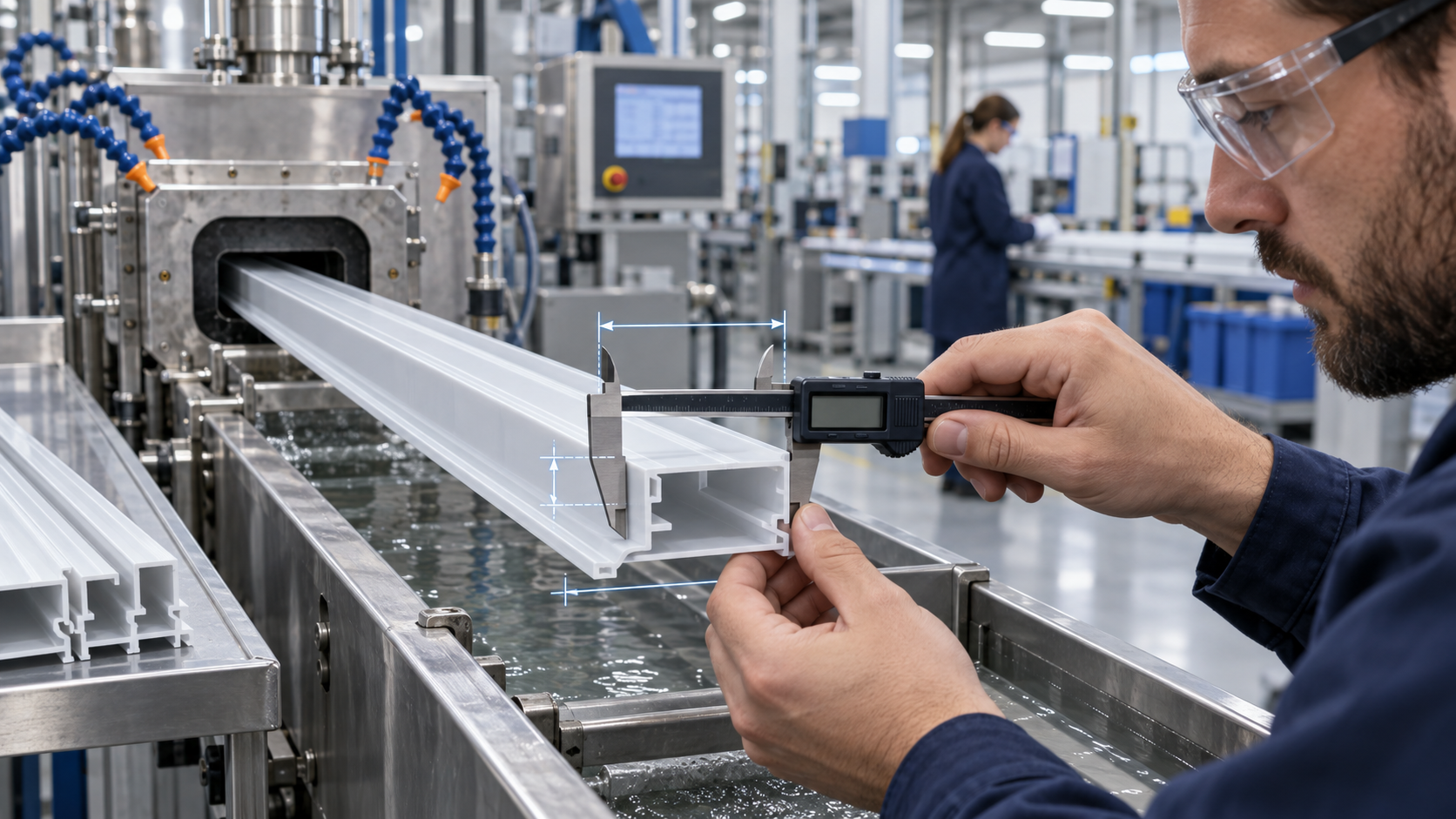
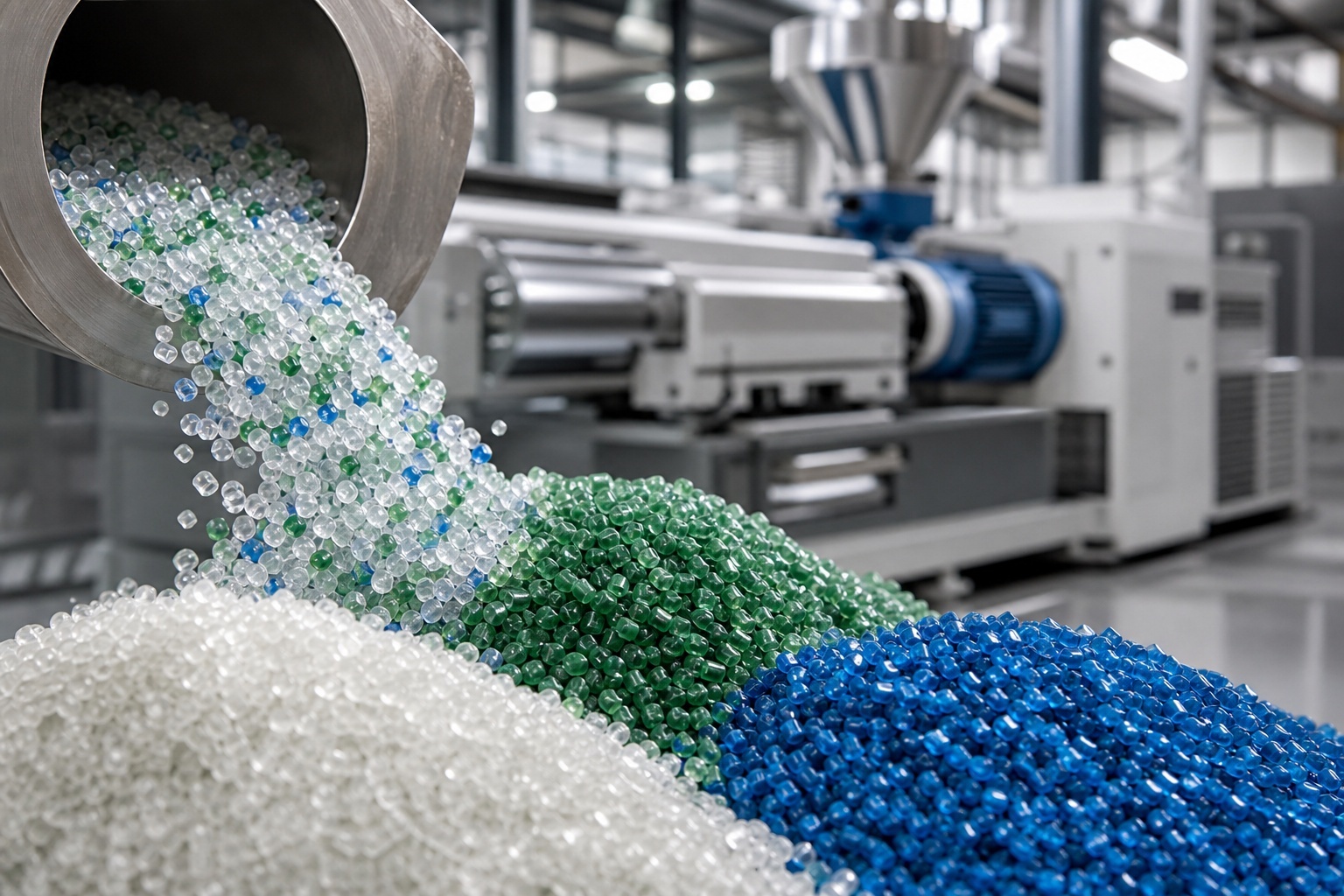
Extrusion is a continuous process. Resin pellets are fed into a heated barrel, melted, and pushed by a rotating screw through a custom-machined die. The die gives the melt its cross-sectional shape. The extrudate is then pulled through a calibration and cooling stage, and cut to length downstream.
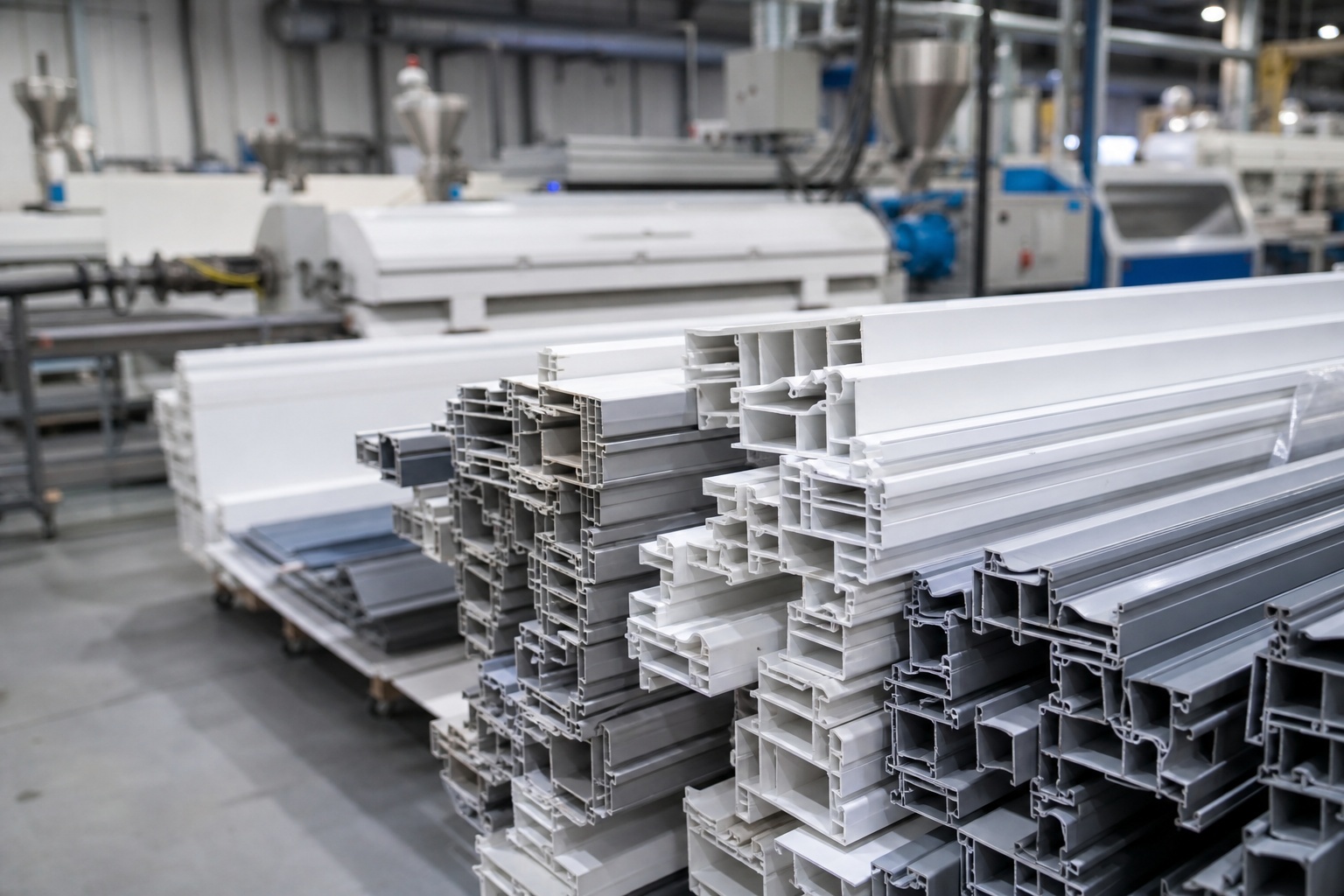
The defining characteristic is simple: extrusion produces parts with a constant cross-section. Tubing, window and door lintels, trim, edge banding, channels, U-profiles, weather seals, protective guards and cable molding are all extrusion territory. Length is essentially arbitrary — the same die can produce a 300 mm clip or a 6 m rail.
For a full walkthrough of the line, see our breakdown of how custom plastic profiles are made.
Where extrusion gets sophisticated
Constant cross-section does not mean simple. Modern extrusion supports:
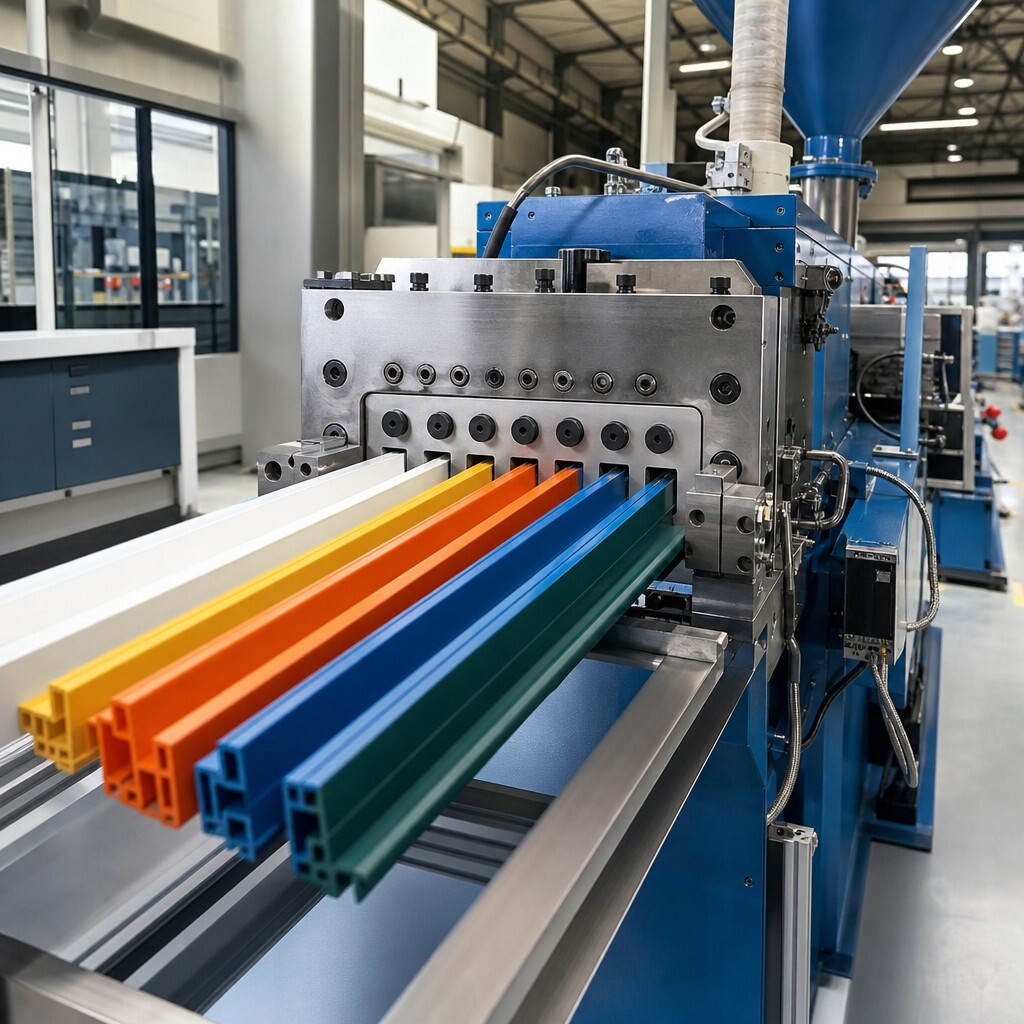
- Co-extrusion — running two or more materials through one die so a single profile can have a rigid structural body and a soft flexible sealing lip, or a UV-stable cap layer over a recycled core. Our co-extrusion capability covers exactly this.
- Dual durometer — hard and soft in one part, no assembly step.
- Secondary operations — in-line die cutting, punching, notching, 3M tape application and decorative laminating, so the profile arrives ready to install.
How Injection Molding Works
Injection molding is a cyclical process. Melted resin is injected under high pressure into a closed, cooled mold cavity, held while it solidifies, then ejected. The cycle repeats — typically every 10 to 60 seconds depending on wall thickness and part size.
Because the part is formed inside a fully enclosed cavity, injection molding can produce genuinely three-dimensional geometry: bosses, ribs, snap fits, threaded features, undercuts, varying wall sections and complex curves. Housings, caps, connectors, gears, clips and enclosures are injection molding territory.
Plastic Extrusion vs Injection Molding: The Key Differences
| Factor | Extrusion | Injection Molding |
|---|---|---|
| Geometry | Constant cross-section, any length | Discrete 3D parts, fixed dimensions |
| Tooling cost | Low — a die is a machined plate assembly | High — a multi-part hardened steel mold |
| Tooling lead time | Typically weeks | Typically months |
| Design revisions | Relatively inexpensive to re-machine | Expensive; major changes can mean a new tool |
| Output | Continuous, measured in linear feet or metres | Discrete, measured in cycles and cavities |
| Best suited to | Profiles, tubes, trim, seals, channels, guards | Housings, caps, clips, brackets, connectors |
Tooling cost is usually the deciding factor
An extrusion die is a comparatively simple piece of tooling: it shapes a cross-section and nothing else. An injection mold has to fill, vent, cool, separate and eject a three-dimensional part, often with side actions and multiple cavities. Industry-wide, extrusion dies commonly land in the low thousands, while a production injection mold typically starts around five figures and climbs quickly with cavity count, surface finish, undercuts and tight tolerances.
For a part that could be made either way, this gap matters enormously at low and medium volumes. If your annual requirement is 20,000 linear feet of a channel section, extrusion amortizes the tooling almost immediately. If you also need a moulded end cap for that channel, that end cap is a molding job — and many finished assemblies are simply an extruded body plus a couple of moulded fittings.
Per-part economics run differently
In extrusion, the dominant cost drivers are resin, line speed and scrap. Faster line speed and a well-designed die that runs stable directly reduce your unit price. In injection molding, cycle time and cavitation dominate — a four-cavity tool that runs a 20-second cycle produces four parts per cycle, which is why molders push for high-cavity tools at volume.
A Simple Decision Framework
Work through these four questions in order:
1. Does the part have a constant cross-section?
Slice the part mentally along its length. If every slice looks identical, extrusion is a candidate — and usually the cheaper one. If slices differ (a boss here, a flange there, a closed end), you are looking at molding, or at extrusion plus a secondary operation.
2. Can you split the assembly?
This is the question most teams skip. A part that seems to require molding often decomposes into an extruded profile plus one or two small moulded or fabricated components. That split can cut total tooling cost dramatically and shorten lead time, because the long profile — the expensive part to mold — becomes the cheap part to extrude.
3. What is the realistic annual volume, and how confident are you?
Extrusion’s lower tooling cost also lowers the cost of being wrong. If your forecast is uncertain, or if the design may iterate after field trials, extrusion’s cheaper and faster die revisions are a genuine risk-management advantage.
4. What performance does the material need to deliver?
Material choice interacts with process. Rigid PVC, ABS, HDPE, polypropylene and TPE all extrude well, and co-extrusion lets you combine them. Our guide to choosing between PVC, ABS and HDPE covers the trade-offs in impact strength, UV stability, chemical resistance and cost.
When Both Processes Appear in the Same Product
In practice, most finished goods use both. A window system uses extruded frames, glazing beads and weather seals, with moulded corner keys and hardware. A point-of-purchase display uses extruded channels and moulded connectors. A protective guard uses an extruded body with a moulded cap.
The practical takeaway for procurement: do not treat this as an either/or supplier decision. Identify which elements are profiles and source them from an extruder who can also handle fabrication, die cutting and assembly in-house — that removes a supplier hand-off and a lead-time risk.
Common Mistakes That Cost Money
- Designing in CAD as a moulded part, then asking for an extrusion quote. Uniform wall thickness, generous radii and draft-free cross-sections are extrusion-friendly. Thick-to-thin transitions cause sink and warp.
- Specifying injection-molding tolerances on an extruded profile. Extrusion tolerances are realistic and repeatable, but they are governed by different physics — see our post on what tolerances are realistic in extruded profiles.
- Committing to a high-cavity mold before the design is validated. Prototype in a lower-cost process first where geometry allows.
- Ignoring secondary operations. A slightly more expensive profile that arrives pre-punched and taped can be far cheaper installed.
Frequently Asked Questions
Is extrusion always cheaper than injection molding?
Not always, but for parts with a constant cross-section it usually is — mainly because the tooling is far less expensive and faster to produce. For complex 3D parts at very high volume, injection molding is the only viable route.
Can extrusion produce hollow parts?
Yes. Tubes, multi-lumen profiles and hollow chambered sections are standard extrusion work, using mandrels and vacuum calibration to hold internal geometry.
How long does extrusion tooling take?
Die design, machining and trial typically run in weeks rather than the months common for production injection molds — though complex co-extrusion dies take longer.
Which process is better for recycled content?
Extrusion handles regrind and recycled resin comfortably, and co-extrusion lets you place recycled material in the core with a virgin cap layer for appearance and weathering.
Can I switch from injection molding to extrusion later?
Only if the geometry allows it. It is far better to evaluate both routes before tooling is cut — which is exactly what a design-for-manufacture review is for.
Get the Process Decision Right Before You Cut Tooling
The plastic extrusion vs injection molding question is rarely about which process is “better.” It is about matching geometry, volume and risk tolerance to the right tooling investment. A one-hour design review before quoting routinely saves months of lead time and tens of thousands in tooling.
Accord Plastics has been designing and running custom extrusion programs for Canadian manufacturers across construction, automotive, appliance, marine and display markets — including in-house engineering, co-extrusion, fabrication and finishing. Before you request pricing, run through our custom extrusion quote checklist so the numbers you get back are accurate.
Have a part you are not sure how to make? Contact our engineering team with a drawing or sketch and we will tell you honestly whether extrusion is the right route.