Colour is often the last thing specified on a drawing and the first thing a customer notices. A trim strip that’s a shade too blue, a profile that drifts between production runs, or a part that fades to chalky grey after one summer can sink an otherwise well-engineered product. Custom colour plastic extrusion solves that problem, but only when designers, engineers, and the extruder agree on how the colour is made, measured, and controlled.
This guide explains how colour gets into an extruded profile, how brand colours are matched, what affects consistency from lot to lot, which tolerances are realistic, and how co-extrusion opens up multi-colour options. It’s written for the product designers and engineers who have to sign off on a colour—and live with it for the life of the part.
How Colour Is Added in Custom Colour Plastic Extrusion
There are three common ways to colour an extruded plastic. Each one trades off cost, flexibility, and consistency differently, so the right choice depends on your volumes and how critical the colour is.
Colour masterbatch (colour concentrate)
Masterbatch is a pellet loaded with a high concentration of pigment, dispersed in a carrier resin. It’s blended with natural (uncoloured) resin at the extruder, typically at a let-down ratio of about 1–4% depending on pigment strength and wall thickness. Masterbatch is the most popular method for custom extrusion because it’s economical, keeps inventory simple (one natural resin, many colours), and suits small-to-medium runs.
The key to success is accurate dosing. Gravimetric blenders that weigh each component deliver far more consistent colour than volumetric feeders, especially on thin-walled profiles where a small change in loading is easy to see.
Pre-compounded (pre-coloured) resin
With pre-compounded material, the pigment is melt-mixed into the resin by the compounder before it ever reaches the extrusion line. Every pellet is already the finished colour. This gives the best dispersion and the tightest consistency, which is why it’s common for high-volume programs and appearance-critical parts. The trade-offs are higher material cost, larger minimum order quantities, and less flexibility if you want to tweak a shade later.
Liquid colour
Liquid colourants are pumped directly into the feed throat. They disperse well and can be cost-effective at low loadings, but they need dedicated pumping equipment and careful housekeeping. In profile extrusion they’re less common than masterbatch, though they’re useful for certain transparent or tinted applications.
Matching Pantone, RAL, or Custom Brand Colours
Most colour programs start from one of three references: a Pantone number, a RAL code, or a physical sample from the customer—often a painted panel, a moulded part, or a competitor’s product.
Why a physical standard beats a code
Pantone and RAL systems were built for inks and paints. Plastics behave differently: the base resin has its own colour and clarity, gloss changes how the colour reads, and wall thickness affects opacity. A Pantone chip is a great starting point, but the approved standard should be a physical plaque or a piece of profile made in your actual material. That way everyone—designer, extruder, and quality inspector—is comparing against the same thing.
The matching process
A typical custom colour match looks like this:
- Target defined: you supply the reference (code or sample) plus the resin, end use, and any lighting conditions that matter.
- Lab match: the colourist formulates a match and measures it with a spectrophotometer, comparing it to the target in L*a*b* colour space.
- Trial run: the formula is run on the extrusion line, because processing heat and shear can shift a colour slightly from the lab plaque.
- Approval: you sign off on a physical master sample, which becomes the standard for all future production.
Accord handles this in-house through our colour matching service, so the match is developed on the same equipment that will run your parts.
Watch out for metamerism
Two colours can match perfectly under shop lighting and look different in daylight or under LED store lighting. This is called metamerism, and it happens when the pigments in the sample and the match are different. If your part will sit next to a painted or moulded component, tell your extruder which light sources matter so the match can be checked under each one.
Factors That Affect Colour Consistency
A good match on day one is only half the job. Holding that colour across months or years of production depends on several variables.
Material type
Every resin starts with a different natural colour. Rigid PVC, ABS, HDPE, polypropylene, and polycarbonate all take pigment differently, so a formula developed for one will not transfer directly to another. Our PVC vs ABS vs HDPE comparison covers how the base materials differ beyond colour.
UV exposure and weathering
Outdoor parts face sunlight, heat, and moisture. Some pigments—especially certain organic reds, yellows, and bright blues—fade much faster than inorganic alternatives. For exterior applications, specify UV stabilizers and weather-resistant pigments up front, and consider a capstock layer (more on that below). A colour that looks perfect at approval but fades in a season isn’t a good match.
Lot-to-lot variation
Natural resin varies slightly between lots, and so does pigment strength. Regrind content, drying conditions, and melt temperature all play a role too. Reputable extruders control this by keeping the master sample on file, measuring production against it at start-up and at regular intervals, and adjusting the let-down ratio within tight limits.
Processing conditions
Overheating some resins can yellow them, and excessive shear can change how pigments disperse. Stable processing temperatures and line speeds are as important to colour as the formula itself.
Colour Matching Tolerances: What’s Realistic?
Colour difference is measured as Delta E (ΔE)—the distance between two colours in L*a*b* space. The smaller the number, the closer the match.
- ΔE below 1.0: most people can’t see a difference side by side. This is reserved for critical appearance parts and usually requires pre-compounded material.
- ΔE 1.0–2.0: a common target for standard custom colour work where parts are seen together.
- ΔE 2.0–3.5: a noticeable difference under close inspection, but often acceptable for functional or hidden components.
Tighter isn’t always better. Every step down in tolerance adds cost through extra testing, longer start-ups, and potentially higher-cost materials. Set the tolerance based on how the part will be seen: is it next to another coloured component, or is it inside an assembly? Our article on realistic tolerances in extruded profiles applies the same thinking to dimensions.
It also helps to specify gloss and texture alongside colour. A matte and a glossy surface in the same pigment formula will look like two different colours.
Multi-Colour and Co-Extrusion Colour Options
Single-colour profiles aren’t your only option. Co-extrusion combines two or more materials—or two colours of the same material—into one profile in a single pass.
Capstock for colour and weatherability
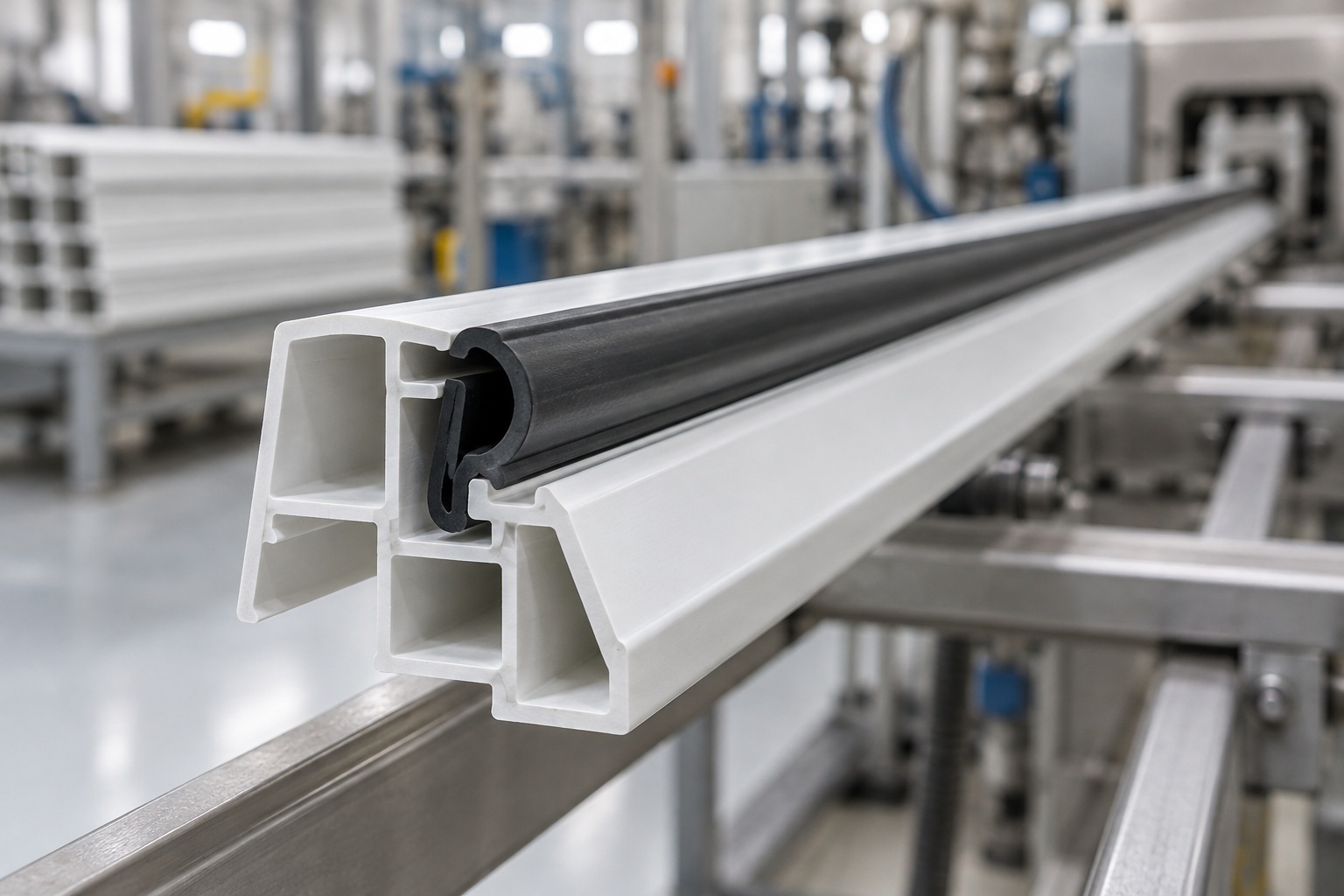
A thin, high-performance outer layer (the capstock) carries the colour and UV protection, while a lower-cost core provides structure. This puts expensive pigments and stabilizers only where they’re needed. Learn more about our cap stocking capabilities.
Stripes, accents, and dual-colour profiles
Co-extrusion can add a contrasting stripe, a coloured lip, or a two-tone profile—useful for branding, safety identification, or decorative trim. For a deeper look at when this approach pays off, see co-extrusion vs single-material profiles.
Rigid and flexible in different colours
A rigid body and a flexible sealing fin can be extruded in different colours, making it easy for installers to see orientation at a glance.
Tips for Specifying a Custom Colour
- Provide a physical sample whenever possible, not just a code.
- State the end-use environment: indoor, outdoor, food contact, or high heat.
- Define the tolerance (ΔE) and the light sources the colour must match under.
- Specify gloss and surface finish together with colour.
- Ask how the extruder measures and documents colour at start-up and during runs.
- Confirm any regulatory needs—food-contact or medical parts need compliant colourants too.
FAQ: Custom Colour Plastic Extrusion
Is there a minimum order for a custom colour?
It depends on the colouring method. Masterbatch-based colours usually have the lowest minimums, while pre-compounded resin may require larger material orders. Ask your extruder early so the colour approach matches your volumes.
Can you match a colour from a competitor’s part or a painted sample?
Yes. A physical sample is often the best starting point. Expect the match to be measured with a spectrophotometer and confirmed on a trial run in your actual material.
Why does my extruded part look different from the Pantone chip?
Pantone chips are printed inks on paper. Resin colour, gloss, translucency, and lighting all change how plastic reads. That’s why an approved physical master sample is more reliable than a code alone.
Will my colour fade outdoors?
It can, unless the formula includes UV stabilizers and weather-resistant pigments. For long outdoor service, a co-extruded capstock is a cost-effective way to protect colour.
How long does colour matching take?
Simple matches can be turned around quickly, while critical or multi-light-source matches take longer because of trial runs and approvals. Build colour approval into your project timeline from the start.
Get Your Colour Right the First Time
Custom colour plastic extrusion works best when colour is treated as an engineering requirement, not an afterthought. Choose the right colouring method for your volumes, approve a physical standard, set a realistic ΔE tolerance, and plan for UV exposure from day one. As a Canadian extruder with in-house colour matching, co-extrusion, and capstock capabilities, Accord Plastics can help you get there—explore our custom extrusion solutions.
Have a colour target in mind? Contact Accord Plastics to discuss your profile, material, and colour requirements with our team.